
The late Michael Gibbons legacy continues in the Toledo Arts District, which he and his wife founded when Murray & Co. bought Wool Goods of the Old Church Studio.
Toledo born Sarah Murray, owner of Murray & Co., bought the studio on June 1st. She will use the first floor of the former United Methodist Church from 1887 as her wool dyeing studio; her husband Ken, information technology manager for the Central Lincoln People’s Utility District in Newport, plans to use the basement for his leather craft.
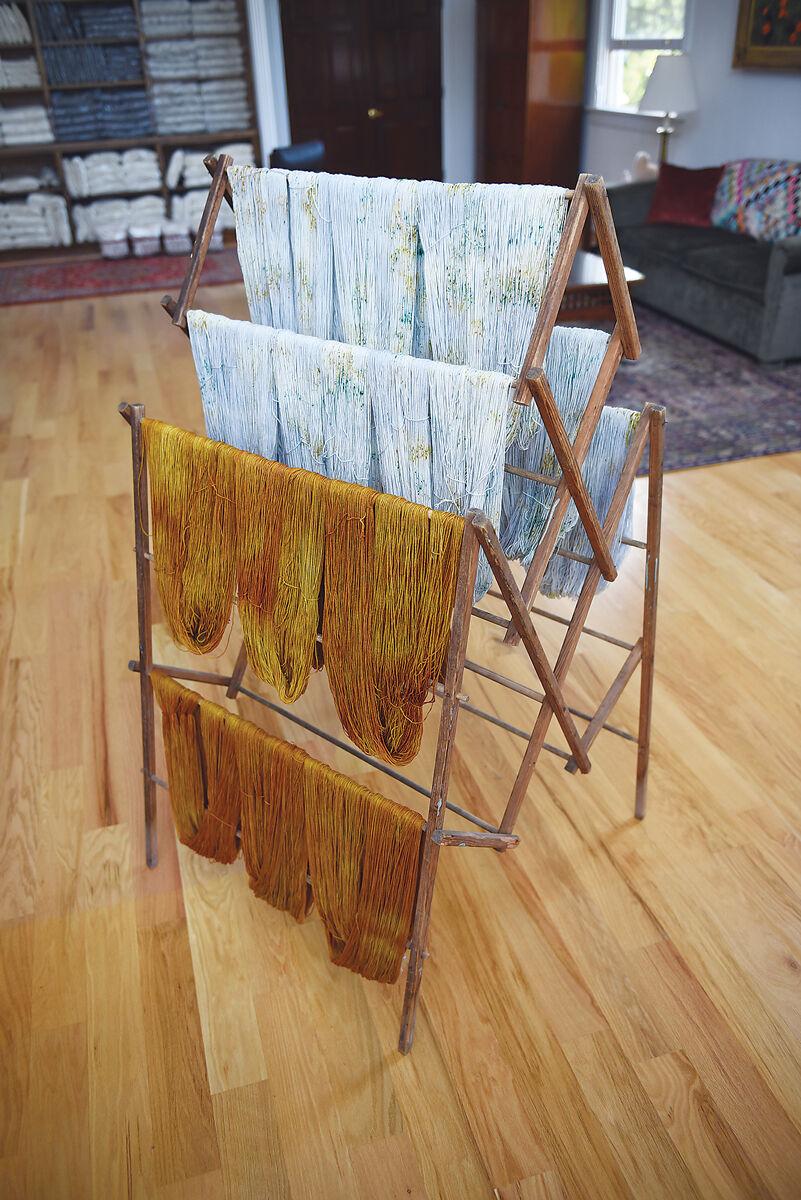
The yarn dries on a rack in Sarah Murray’s virgin wool dye works in the historic Old Church in Toledo.
Sarah Murray started dyeing wool in her Toledo kitchen, moved her workspace to the basement to make more space, and eventually expanded to a shed her husband built in her backyard. The old church will give her even more space to pursue her craft – hand-dyeing wool for knitting and crocheting.
Murray’s family, originally from Toledo, moved away growing up but returned to visit in the summer. They eventually settled in Toledo, where she graduated from Toledo High School.
Murray moved many times for her husband’s career as a Navy pilot, but they settled in Toledo 16 years ago to be close to the family.
“I started college with an emphasis on the arts and my love is drawing pencils, especially portraits,” said Murray. “Immediately after we got married, Ken joined the Navy and we moved to flight school in Pensacola, Florida. My dream has always been to be a mother, so I focused on having a family. ”They now have two daughters in college.
While she was homeschooling her daughters, Murray continued her interest in arts, be it drawing, quilting, or knitting. “After I became a mother, I fell in love with fiber art,” she said. Mostly self-taught, she said her grandmother taught her to knit when she was in third grade.
“I grew up with a clever mother and grandma who always knitted quilts or blankets and slippers for us,” she recalls. “I love making functional and cozy art that my loved ones can enjoy. I knit every day now. It’s really relaxing for me. “
When Murray decided to create her own colors for her knitting projects, she learned to dye wool by hand. They do not spin their own yarn except as a hobby, but buy their yarn ready for dyeing.
Most of Murray’s business is mail order through their website and is a striking example of the power of social media. She started posting on Instagram in 2012 to connect her quilting with others in the creative community. “I have a little following,” she said. “Then I started dyeing yarn and I shared what I was doing on Instagram and people saw it and asked if they could buy the yarn. Now I have customers all over the world who found me on Instagram – I feel like I met people that way. “
She also sells her thread at the Knotty Lamb thread store in Forest Grove, where she occasionally hosts quilting shows.
And with the purchase of the Old Church, she will be able to meet knitters in person in her studio, filled with woolen threads dyed in countless colors.
“It will be nice for local knitters and crocheters to have a local yarn store and be able to shop locally,” she said. “Being able to see and touch the wool is so nice when you try to imagine what you want to do handicrafts. You want to crush the wool and smell it. “
Your process of dyeing is straightforward. She orders wool from wholesalers – “I source ethically raised sheep,” she said, noting that some American, other South American suppliers of wool are – and starts with bare, undyed strands of yarn and then soaks the yarn in water to prepare it to add the dye to accept. The wet strand is placed in a pan with water and citric acid or vinegar and the paint is applied. The mixture is then boiled and the acid and heat bind the dye to the wool fibers. After dyeing, the wool is cooled, washed and hung up to dry.
“Some strands go through many layers of paint to get the colors you want, and it can take hours,” Murray explained. “I buy dyes like a painter would buy paints. And then I mix them. “
From start to finish, the staining process takes a couple of days.
Murray said the studio will be open to the public on “open studio” days, a time when local knitters and crocheters can visit and shop. She can also offer workshops. But both are for the future. At the moment she is still working on setting up the studio and getting used to the immense space.
“It’s going to be fun. Michael Gibbons is a lot to live up to,” she said, reflecting on the work in the late artist’s long-standing studio. “I’ve known Michael and Judy for so many years and not only appreciate his art, but also what he did for the neighborhood and other artists.
“Michael was a fixture in the neighborhood,” she added, noting that she lived around the corner from Gibbons’ house and gallery and often stopped to chat while walking her dog. “It’s bittersweet – we really miss him, but we’re also grateful for the opportunity to create in his studio.”
Judy Gibbons is also pleased that the Old Church has been sold to a practicing craftsman. “We all welcome Sarah to the Toledo Arts District, and personally, I am particularly excited about the crafting work at the Old Church Studio,” she said. In 1992 Michael and Judy Gibbons bought the Old Church, and the following year Michael moved his studio there. A March 1993 News-Times article stated that the purchase was part of the couple’s plan to develop the neighborhood into an arts district, one block up from Main Street.
Judy Gibbons stated that she and Michael applied to the Oregon Department of Road Signs for Highway 20 signage for their studio and gallery in the Episcopal Vicarage on Northeast Alder Street. During the mandatory photography of the street on Northeast First Street off Business Highway 20, state officials came several times to review their request. They were “completely surprised,” she said when they received a sign for the fledgling Arts District, which now runs from Northeast Alder Street next to Business 20 to Elks Lodge.
Gibbons was thinking about his plans to renovate the historic buildings on Northeast Alder Street at the time and told this reporter, “My feeling – and I’ve had for years – is that the growth of Oregon or any culture is an influx of artists, people that have traditionally settled in places that are not very expensive. Toledo is a natural … you don’t have to put a gallery in a high pedestrian area. You just have to focus the quality of the art on one area so that those interested will want to see it. “
“Now another art form is going to take place here,” said Judy Gibbons of Murray’s wool dyeing business. “I am excited and enthusiastic. It is my pleasure to welcome Murray Wool to the Toledo Arts District. ”
Murray can be contacted at [email protected]. Your website is murraywoolgoods.com.

/cloudfront-us-east-1.images.arcpublishing.com/gray/UGTUQTJV7RFD7CA3QBHMN5C5EQ.jpg "Police make arrest in South Toledo homicide case")
