With art that depicted everything from drawings of people he met to vibrant cityscapes, the painter has captured the pulse of Cleveland in his work.
With his gritty and vivid acrylic on canvas paintings depicting daily urban life in Cleveland, Michelangelo Lovelace’s art spoke volumes on a range of social issues, one of the main themes being the disparities between rich and poor. Lovelace’s family and friends – who died of pancreatic cancer in April at the age of 60 – say the artist himself was a being far quieter than his exuberant work.
“He wasn’t a man of many words,” recalls Shirley Lovelace, Michelangelo’s widow. “Everything he had to say he would bring to his art.”
Born and raised in Cleveland, Lovelace often told the story of being arrested as a teenager for selling marijuana and almost hired by the judge to pursue his passion for art as an alternative to prison. He spent the next 40 years creating art that ranged from erotic charcoal drawings and intimate line sketches of people he met to his more recognizable full-color cityscapes – all in hopes that he would see people for a moment Could bring a pause.
“His art was his belief and he always wanted people to feel something that made them think about life,” says Shirley.
Lovelace has received Cleveland awards over the years, including the prestigious Cleveland Arts Prize Mid-Career Award in 2015. In 2007 he made headlines when his play “My Home Town” showed a Cleveland panorama – with mostly white faces on the “West Side”. “Of the painting and black faces on the” East Side “- was removed from the main building of the Cleveland Clinic after being accused of adopting stereotypes. The piece now hangs in the Cleveland Museum of Art.
“People came into the gallery and said they saw their life and family in its pictures,” says Adam Tully, co-owner of the Maria Neil Art Project in the Waterloo neighborhood, which featured Lovelaces art on its 2013 streetology show.
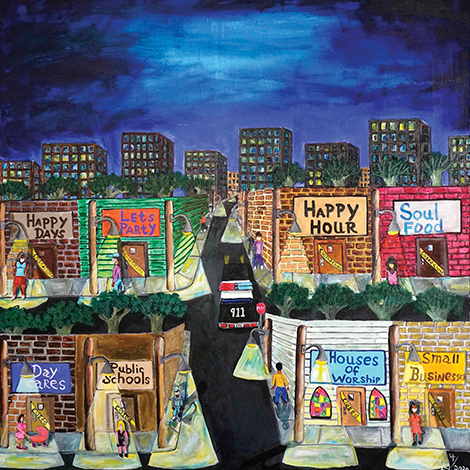
According to all reports, Lovelace had an unmatched work ethic and took the time to work on his craft every day, despite having full-time jobs in everything from maintenance to nursing assistance. Tully points out that Lovelace had an innate creative urge, although his aversion to public speaking sometimes got in the way of his work that attracted wider attention.
“Michelangelo wasn’t the type to run up to a gallery owner and hypocrite his own work,” says Tully. “He wanted his art to speak for him, which it always did loudly and powerfully.”